
A 3-year-old who cheers after rolling a ball toward a target is not asking whether their grip is correct. They are learning that their body can try, adjust, and succeed. That is the right place to introduce golf through purposeful play: not with pressure to perform, but with simple, joyful experiences that help a child feel capable.
For young children, golf can be much more than a sport. When it is taught in an age-appropriate way, it becomes a setting for balance, coordination, listening, turn-taking, and confidence. The club and ball are simply tools that make these early learning moments exciting.
Why Purposeful Play Comes Before Technique
Children ages 2 to 5 learn best through movement, repetition, imagination, and connection with a trusted adult. A long explanation about stance or swing mechanics will rarely hold their attention. A game that invites them to tap a ball to a colorful target, however, gives them a reason to move, focus, and try again.
Purposeful play is not unstructured free time. It is play with a developmental goal. A child may be practicing hand-eye coordination while sending a ball through a gate, body awareness while carrying a club safely, or patience while waiting for a parent to take a turn. The activity feels like a game, while the skills behind it are meaningful and transferable.
This approach also respects where young children are emotionally. At this age, confidence grows through small wins. When a child hears, “You kept trying,” or “You noticed where the ball went,” they learn that effort and curiosity matter. That message is far more valuable than being told to hit the ball farther.
How to Introduce Golf Through Purposeful Play
The best first golf experiences are short, active, and flexible. They give children a clear challenge without making the outcome feel too serious. A child who loses interest after a few minutes is not failing. They are communicating that it is time to change the game, take a movement break, or finish on a positive note.
Start with movement, not a full swing
Before asking a child to hit a ball, invite them to explore the movements that make golf possible. They can balance on one foot like a flamingo, roll a ball with both hands, walk along a line, reach for a target, or gently sweep a soft ball across the floor with a child-sized club.
These actions build the core motor skills that support later golf development. Balance helps a child stay steady. Bilateral coordination helps them use both sides of their body together. Spatial awareness helps them understand where the club, ball, and target are in relation to one another.
A full swing is a complex movement, and there is no need to rush it. Small putting motions and gentle taps are often a better starting point because children can see the result quickly. That immediate feedback keeps the experience satisfying.
Turn each activity into a simple mission
Young children respond well when a game has a story or a clear purpose. Instead of saying, “Practice putting,” try, “Can you help the ball find its home?” A hoop, cone, bucket, or taped square can become the destination.
Keep the challenge close enough for success. If the target is too far away, children may become frustrated before they have had a chance to enjoy the movement. As confidence grows, make small changes: move the target a little farther, create a wide pathway, or ask the child to roll the ball around an obstacle.
Variety matters more than complexity. One day, a child might tap a ball to a target. Another day, they might collect balls by color, carry a beanbag on a club, or take turns choosing the next destination. Each activity can support golf readiness while keeping play fresh.
Let parents be active partners
Parent-child participation is one of the strongest parts of an early golf experience. A parent provides reassurance, models safe behavior, and celebrates effort in real time. For a young child, that shared attention often matters more than the game itself.
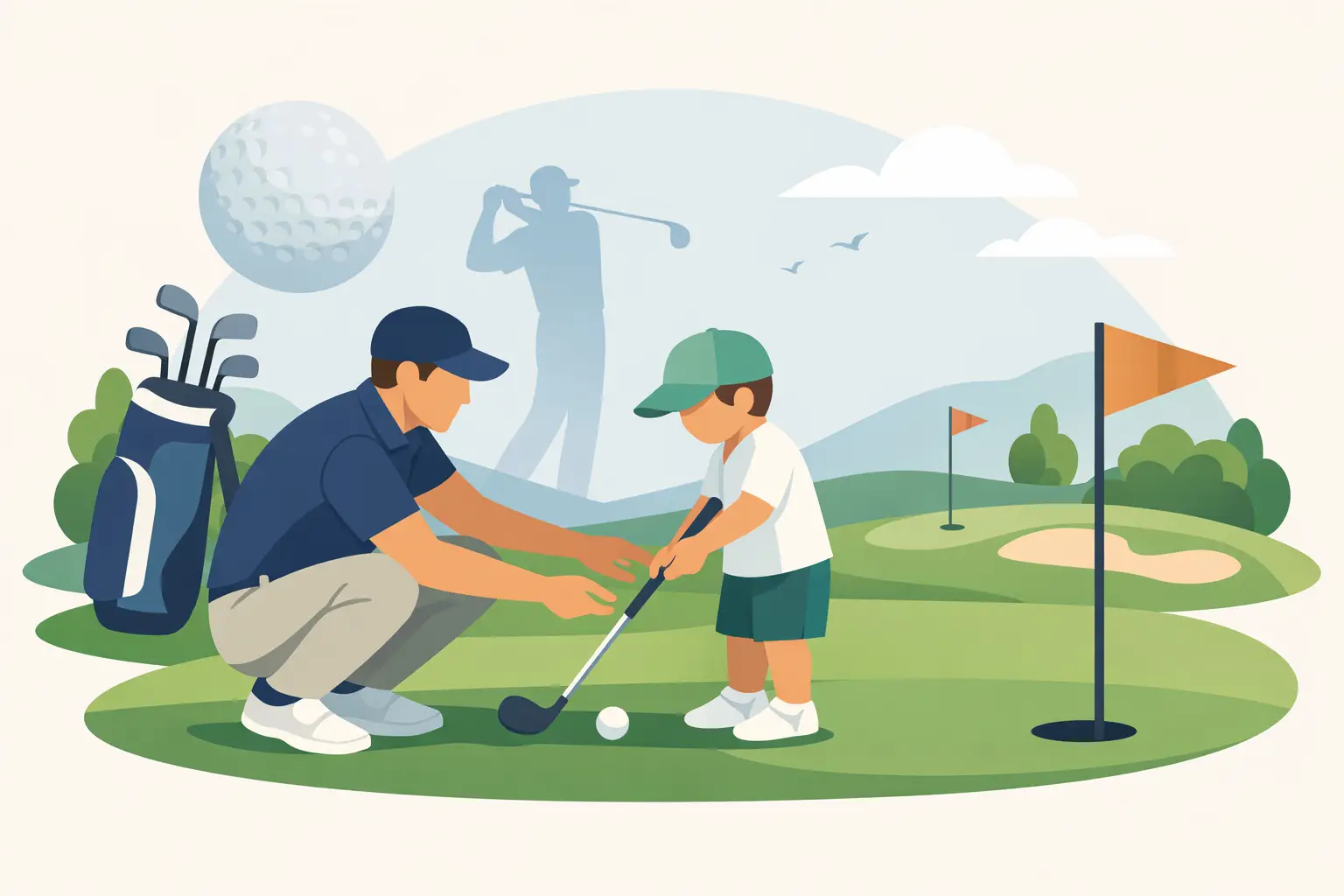
Parents do not need golf knowledge to participate well. They can kneel beside their child, demonstrate a gentle roll, ask simple questions, and notice progress. “Would you like to try from here or there?” gives a child an appropriate choice. “You waited until the space was clear before swinging” recognizes safe, thoughtful behavior.
It helps to resist the urge to correct every movement. Too much instruction can turn a playful moment into a test. If a child holds the club differently or uses a creative approach to move the ball, allow room for exploration as long as it is safe. Guidance should be brief, kind, and followed by another chance to play.
Use praise that builds confidence
The most helpful praise focuses on what the child did, not only whether the ball reached the target. Rather than saying, “Great shot!” every time, be specific: “You looked at the ball before you tapped it,” or “You used a gentle touch and the ball stayed on the path.”
This kind of feedback helps children connect their actions to outcomes. It also makes it easier for them to recover when something does not go as planned. A missed target becomes information, not a disappointment. You might say, “That ball went to the left. Shall we see what happens if you tap it a little softer?”
There is a balance to find. Children should feel encouraged, but they should also have space to notice their own progress. A quiet smile, a high-five, or a pause to let them celebrate can be just as powerful as a stream of praise.
What Purposeful Golf Play Teaches Beyond Golf
A well-designed golf activity can support several areas of early childhood development at once. Children practice gross motor skills as they walk, bend, reach, and swing. They strengthen fine motor control when they pick up balls, place them on a starting spot, or guide a small club with care.
They also develop social and emotional skills. Taking turns teaches patience. Following a simple sequence builds listening skills. Returning equipment to its place encourages responsibility. When a child tries again after a ball misses its target, they practice resilience in a low-stakes setting.
Golf naturally creates opportunities for early learning, too. Parents can count how many balls reach a target, name colors, compare near and far, or talk about direction. The goal is not to turn playtime into a lesson plan. It is to notice the learning already happening and respond to the child’s interest.
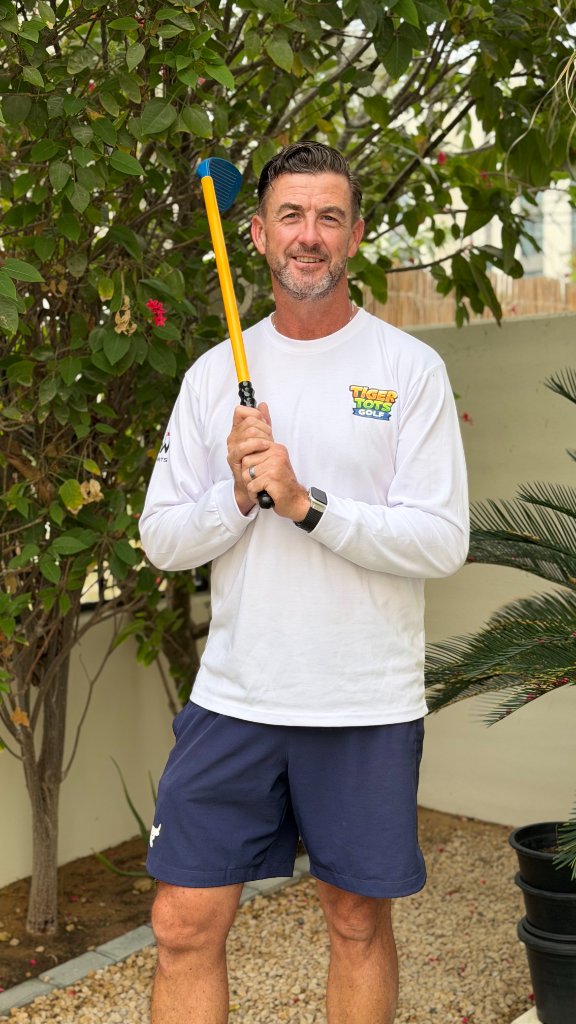
At TigerTOTS Golf, these developmental moments are built into structured parent-child activities so children can enjoy an introduction to golf without being asked to behave like older players. The pace, equipment, and games should always fit the child in front of you.
Creating a Positive First Experience at Home
You do not need a golf course or a formal setup to make golf play meaningful. A safe open area, soft balls, and a child-friendly club or putting tool are enough. Indoors, use a hallway or a clear section of a living room. Outdoors, a patch of grass or a shaded paved space can work well.
Begin with a simple safety routine. Teach children that clubs stay low, that they look around before moving, and that balls are for rolling or tapping, not throwing toward people. Keep the language calm and repeat the same cues each time. Consistency makes safety feel familiar rather than restrictive.
Aim for a short session that ends while your child is still enjoying it. Five to ten focused minutes may be plenty for a toddler, while some preschoolers may happily play longer. It depends on the child’s energy, attention, and mood that day. Stopping after a successful try helps them look forward to the next session.
Most of all, follow your child’s lead. If they want to repeat the same target game ten times, that repetition is valuable. If they would rather carry balls, make a path, or pretend the target is a treasure chest, their imagination is helping them engage. Purposeful play works best when the adult brings the structure and the child brings the joy.
The first goal is not to raise a golfer. It is to give a young child a safe place to move, connect, and discover what they can do, one cheerful tap at a time.