A preschooler does not need to hit a perfect shot to gain something meaningful from a golf club. They may be learning to place their feet, follow an object with their eyes, take turns, and try again after a miss. These small moments are exactly why parents can improve preschool coordination with golf when activities are designed around play, not performance.
For children ages 2 to 5, coordination is still taking shape. Their movements can be wonderfully energetic one moment and wobbly the next. Purposeful golf activities give that energy a friendly direction, helping children practice balance, body control, hand-eye coordination, and spatial awareness while sharing time with a parent they trust.
Why coordination matters in the preschool years
Coordination is more than catching a ball or swinging a club. It is the ability to get the eyes, hands, feet, and body working together for a task. A child uses it when climbing stairs, putting on shoes, carrying a cup, drawing a picture, or stepping around a friend on the playground.
Preschoolers develop these skills through repetition and variety. They need opportunities to reach, bend, walk, rotate, stop, and change direction. They also need enough time to explore without being corrected at every turn. The aim is not polished technique. The aim is to help children feel capable in their bodies.
Golf is especially useful because it naturally invites controlled movement. A child tracks a ball, positions a club, moves through a swing, and watches what happens next. Even a gentle tap toward a target calls for attention and coordination in a way that feels like a game.
How golf activities support developing bodies
Age-appropriate golf play works best when the equipment is child-sized, the space is safe, and expectations are simple. Rather than asking a preschooler to copy an adult swing, begin with movements they can understand: roll, tap, reach, step, turn, and stop.
Hand-eye coordination through simple targets
Putting is a natural starting point. When a child taps a large, lightweight ball toward a wide target, they practice looking at the ball, judging distance, and adjusting the movement of their hands. At first, the target may be only a few feet away. A cup, cone, or soft tunnel is enough.
Success should be measured by participation, not by how often the ball goes in. If your child taps the ball sideways, laughs, and tries another time, they are still learning. Gradually, they begin to notice that a softer tap sends the ball a shorter distance and a stronger tap sends it farther. That cause-and-effect learning supports coordination as well as problem-solving.
Balance and body control in every swing
A golf swing, simplified for young children, encourages a child to stand with feet apart, shift weight, turn their body, and remain steady through a movement. Those are valuable gross motor experiences. A preschooler may start with a short two-handed push or a gentle side-to-side motion before attempting anything that looks like a traditional swing.
Balance activities can be built into the game. Ask your child to make a "statue stance" before their turn, step over a foam noodle to reach the ball, or walk along a line to their starting spot. These playful challenges teach body awareness without making the session feel like an exercise class.
Bilateral coordination and crossing the body
Young children also benefit from using both sides of the body together. Holding a club with two hands, carrying a ball and club at the same time, or placing a ball on a tee requires cooperation between the left and right sides.
A gentle swing can also encourage a child to move across their body’s center line. This is a normal part of developing coordinated movement. There is no need to force a particular hand preference, though. Let your child choose the side that feels most comfortable, and keep the focus on safe, confident movement.
Improve preschool coordination with golf through purposeful play
The difference between a helpful golf session and a frustrating one is often the setup. Preschoolers do best with short activities, clear choices, and plenty of chances to move. Ten focused minutes can be more valuable than a long session that asks them to wait or repeat a movement after they have lost interest.
Try creating a tiny course with three stations. At one station, your child rolls a ball to a target. At the next, they tap a ball through a wide gate made from two cones. At the last, they carry a ball on a small tray or in both hands to a finishing spot. The variety keeps attention high while practicing different forms of coordination.
You can also use stories. Perhaps the ball needs to cross a river, visit a friend, or find its home in a bucket. Imaginative play gives a child a reason to move and often reduces the pressure they may feel around getting something "right."
If your child is excited and wants to repeat a favorite station, let them. Repetition builds familiarity. If they would rather chase the ball than tap it, bring the target closer and turn the chase into part of the game. Following a child’s interest does not mean abandoning structure. It means using structure in a way that supports their developmental stage.
The parent’s role: guide, encourage, and join in
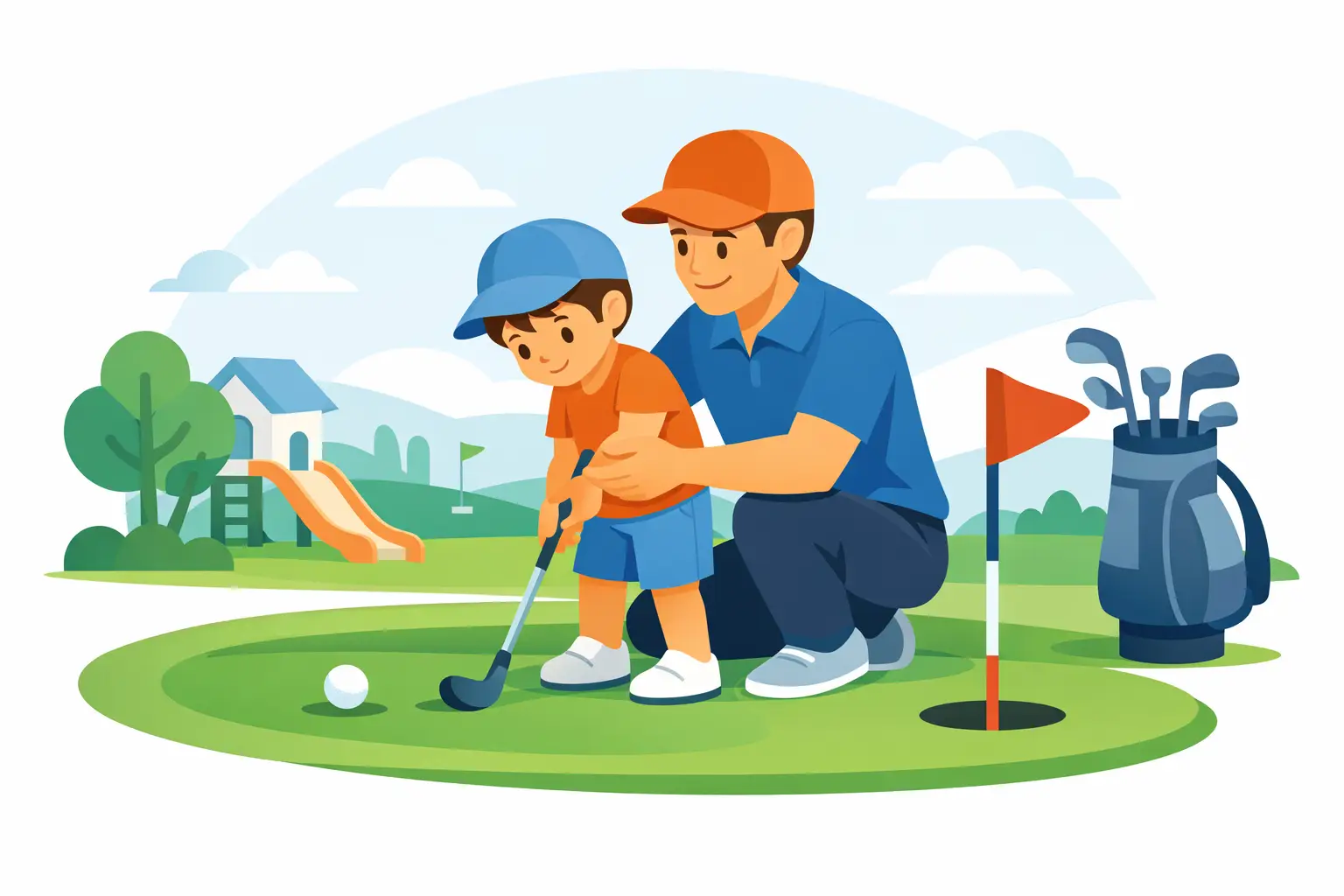
Parent-child participation is one of the strongest parts of early sports learning. A familiar adult helps a child feel secure enough to try an unfamiliar movement. Your calm presence also helps them manage the disappointment of a missed ball or the excitement of a successful shot.
Instead of giving a series of technical instructions, use one simple cue at a time. You might say, "Eyes on the ball," "Soft tap," or "Feet like a strong tree." Then pause and let your child respond. Too many words can make a preschooler feel unsure, while a short cue gives them something manageable to remember.
Praise effort in a specific way. "You kept both hands on the club" is more helpful than a general "Good job" because it tells your child what they did well. You can also notice their persistence: "That ball missed the target, and you tried again." This helps golf become a confidence-building activity rather than a test.
At TigerTOTS Golf, structured parent-child activities are designed around this kind of purposeful play, giving young children a supportive space to build core movement skills alongside someone they know and trust.
Keep golf play safe and age-appropriate
Safety creates the freedom for children to explore with confidence. Choose lightweight, child-sized equipment and soft balls whenever possible. Make sure only one child swings in a designated area at a time, and establish a simple rule: clubs stay low until it is your turn.
Open space is helpful, but a large course is not necessary. A clear area in a yard, park, playroom, or hallway can work for rolling and putting activities. Keep targets soft, remove tripping hazards, and stay close enough to guide the club when needed.
It also helps to end while your child is still enjoying the activity. Preschoolers often communicate fatigue through silliness, wandering, or frustration. That is not a failure. It is a signal to finish with an easy success, such as rolling the ball into a nearby bucket, and save more for another day.
What progress may look like
Coordination growth rarely appears as one dramatic breakthrough. It often shows up in quieter changes: your child steadies their feet before a tap, watches the ball more closely, uses a gentler touch, or recovers more easily when the ball does not go where they expected.
Some children will be drawn to the movement of swinging, while others enjoy setting up targets or collecting balls. Both forms of participation have value. A child who carefully places a ball on a tee is practicing focus and hand control. A child who walks back and forth to retrieve balls is building balance and spatial awareness.
Every child develops at a different pace. If a task seems too hard, make the target wider, shorten the distance, use a larger ball, or switch from hitting to rolling. Small adjustments protect confidence and make it more likely that your child will want to return to the activity.
The best golf moments in the preschool years are not defined by scorecards. They are the moments when your child stands a little taller, gives a new movement a try, looks to you with pride, and says, "Can we do that again?"