The first time a toddler picks up a golf club, it rarely looks like golf. It looks like curiosity, a wobbly stance, a backward swing, and a proud smile after barely tapping the ball. That is exactly why learning how to teach toddlers golf should begin with play, not pressure. At this age, the goal is not perfect technique. It is helping your child build confidence, coordination, body awareness, and a positive connection with movement.
For children ages 2 to 5, golf works best when it feels like a game they get to share with you. Toddlers learn through repetition, imitation, and short bursts of activity. They do not need a long lesson or technical corrections. They need simple language, clear routines, and lots of encouragement.
How to teach toddlers golf starts with the right goal
Many parents make the mistake of thinking golf instruction has to start with grip, posture, and swing mechanics. Those pieces matter later, but early success comes from something more foundational. A toddler first needs to learn how to balance, turn, reach, aim, and stay engaged in a structured activity.
That is why golf can be such a valuable early childhood activity when it is taught appropriately. A gentle putting game can strengthen focus. A simple swing can support coordination across both sides of the body. Taking turns can build patience and social awareness. When parents approach golf as purposeful play, children get the benefits of movement learning while also enjoying the experience.
This is also why expectations matter. Some toddlers love the equipment right away. Others are more interested in carrying balls, setting up targets, or running to collect them. That still counts as learning. In early childhood, participation is progress.
Create a toddler-friendly golf environment
The setup can make or break the experience. Toddlers respond best to a space that feels safe, simple, and easy to understand. You do not need a full practice area or a perfect lawn. A small open space indoors or outdoors is enough if you keep distractions low and the activity short.
Choose lightweight, age-appropriate equipment whenever possible. A plastic club, a toddler-sized putter, soft foam balls, or oversized target holes all make success more likely. If the club feels too heavy or the ball is too difficult to strike, frustration appears quickly.
Keep sessions short. For most toddlers, 10 to 15 minutes is plenty. Some days, five focused minutes will go better than a longer session. Stopping while your child is still happy often works better than pushing for one more round.
Your own energy matters too. If you sound excited, calm, and encouraging, your child is more likely to stay open and engaged. If the mood becomes corrective or rushed, the learning often shuts down.
Start with putting before full swings
Putting is usually the best place to begin. It is slower, simpler, and easier for toddlers to understand. It also gives children a quick sense of success, which matters more than most parents realize.
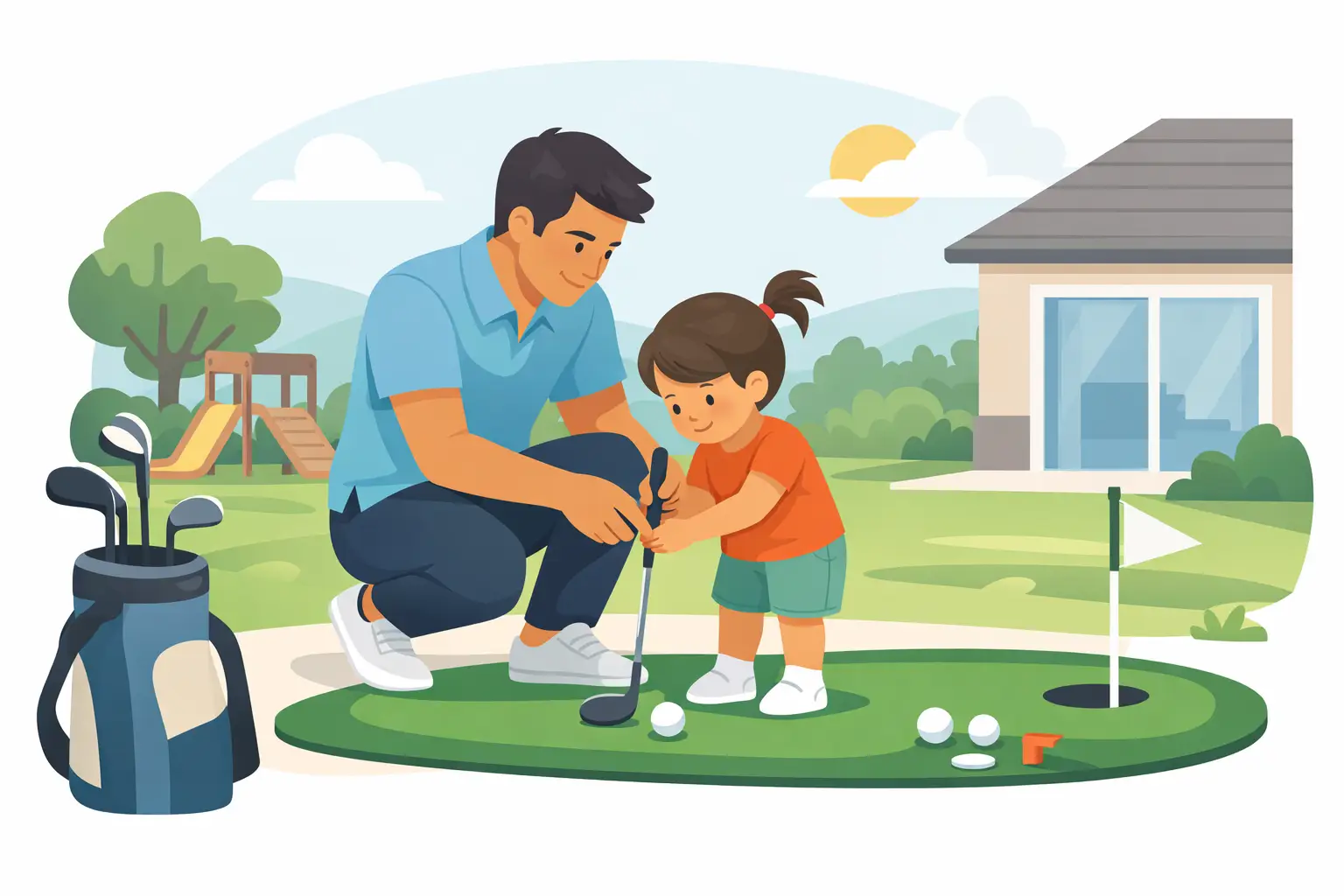
Set up a large target and invite your child to roll the ball into it with a gentle tap. You can call it a game instead of a drill. Try phrases like, "Can you make the ball visit the circle?" or "Let’s see if the ball can go to sleep in the hole." Playful language keeps young children connected.
Once your child understands that the club moves the ball toward a target, you have the beginnings of golf. From there, you can slowly add more distance, different targets, or simple turn-taking games.
Use simple cues your toddler can actually follow
One of the best answers to how to teach toddlers golf is to reduce your words. Young children do not process long instructions well, especially during movement. A short cue paired with a demonstration is far more effective than a detailed explanation.
Try cues like "feet still," "tiny swing," "tap the ball," or "look at the target." These are easier to remember and easier to repeat. If you want your child to copy a motion, show it first and keep your own action exaggerated and clear.
It also helps to teach one idea at a time. If your toddler is learning to hold the club, do not correct stance and aim in the same moment. If they are trying to hit the ball, do not stop to adjust every detail. Too much feedback can make a young child feel like they are doing everything wrong.
A good rule is to celebrate effort first, then guide gently if needed. "You made great contact" lands much better before "let’s try pointing the club to the target." Confidence supports learning.
Make movement skills part of the lesson
Toddlers are not just learning golf. They are learning how their bodies move. That means the best golf activities often look like playful coordination games.
You might ask your child to balance on one foot like a flamingo before a putt. You can place colored markers on the ground and have them step to the red one, then the blue one, before swinging. You can roll balls to a target, carry them in a bucket, or reach across the body to place tees. These little tasks build motor planning, balance, hand-eye coordination, and spatial awareness.
This is especially useful for children who are not yet ready to strike a ball consistently. They can still build the foundation that later makes golf easier and more enjoyable. At TigerTOTS Golf, this development-first mindset is what helps golf feel accessible to young children and reassuring for parents.
Follow your child’s pace
Some toddlers want to repeat the same putt 20 times. Others want to switch between hitting, collecting, and pretending. Both responses are normal. Young children often learn through variation rather than strict repetition.
If your child seems restless, change the activity instead of insisting on more focus. Move from putting to target tossing. Turn the club into a pointer and ask them to aim at colors or shapes. Create a mini obstacle path before the shot. Flexibility keeps the experience positive.
That said, structure still helps. A simple rhythm such as warm-up game, putting game, finish with a favorite challenge gives children a sense of predictability. They feel secure when they know what comes next.
Know when to teach and when to just play
There is a difference between inviting skill development and over-teaching. Toddlers do best when the adult leads with connection. Sometimes that means letting the session be silly. Sometimes it means noticing that your child is tired and ending early.
If your toddler is throwing the balls, running away, or losing interest, it does not always mean they dislike golf. They may need more movement, a different activity, or simply a break. Early childhood learning is rarely linear. A child who seems uninterested one week may be fully engaged the next.
It also depends on temperament. Some children love routine and will happily repeat the same setup. Others need novelty and imagination to stay involved. Good teaching adapts to the child in front of you.
How to teach toddlers golf without creating pressure
Praise can be helpful, but the type of praise matters. Instead of focusing only on outcomes like making the ball in the hole, notice the process. Say, "You stayed so balanced," or "I love how carefully you aimed." That teaches your child that effort, attention, and persistence matter too.
Avoid comparing siblings or pushing performance too early. Toddlers are sensitive to adult reactions, and they quickly pick up on whether an activity feels safe or stressful. If golf starts to feel like a test, many children will resist it.
A better approach is shared enjoyment. Let your child see that you are participating with them, not judging them. Sit close. Take turns. Cheer small wins. Laugh at the misses. Parent-child connection is often what keeps toddlers coming back to the activity.
Build a routine your child can grow with
Consistency helps skills stick. A short weekly rhythm at home can make a real difference, even if it is only one or two brief sessions. Repeating familiar games builds comfort, and comfort builds confidence.
You do not need to introduce something new every time. In fact, toddlers often thrive when favorite activities return. One week you might focus on putting to colored targets. The next week, use the same target game but add a starting line. Those small layers are enough.
As your child grows, you can gradually increase challenge. Make the target smaller, add a simple backswing, or introduce taking turns with a parent. Just be careful not to move faster than your child’s confidence.
If you are wondering how to teach toddlers golf well, the most reliable answer is this: make it playful, make it age-appropriate, and make it something you do together. Children this young do not need polished instruction. They need encouraging adults, developmentally sound activities, and room to explore at their own pace. When golf begins with joy and connection, the skills have a much better place to grow.
The best early golf lesson is not the one with the straightest shot. It is the one that leaves your child asking, with a smile, if they can play again tomorrow.