One day your toddler is running full speed across the living room, and the next they trip over their own feet while trying to kick a ball. That back-and-forth is completely normal. If you are wondering how to improve toddler coordination, the goal is not perfect movement. It is helping your child build body awareness, balance, timing, and confidence through playful, repeated experiences.
For toddlers, coordination develops in layers. A child learns to steady their body before they can control a swing. They learn to track a moving object before they can catch it. They practice shifting weight, reaching, turning, stopping, and starting long before any sport-specific skill looks polished. When parents understand that process, it becomes much easier to support progress without pressure.
What coordination really means in toddler years
Coordination is often treated like a single skill, but for young children it is really a combination of many small abilities working together. It includes balance, posture, hand-eye coordination, foot-eye coordination, core strength, spatial awareness, and the ability to plan movement.
That is why two toddlers can look very different and still be developing well. One child may climb confidently but struggle to throw. Another may love rolling a ball back and forth but feel unsure on uneven surfaces. Coordination does not improve in a perfectly even line. It grows through practice, maturity, and exposure to varied movement.
For parents, this matters because the best support is broad support. Instead of asking, “How do I teach my child one skill?” it helps to ask, “How do I give my child more chances to move with purpose?”
How to improve toddler coordination through play
Toddlers learn best when movement feels like play, not correction. A good activity is simple enough for success but open enough for exploration. That balance is where real skill-building happens.
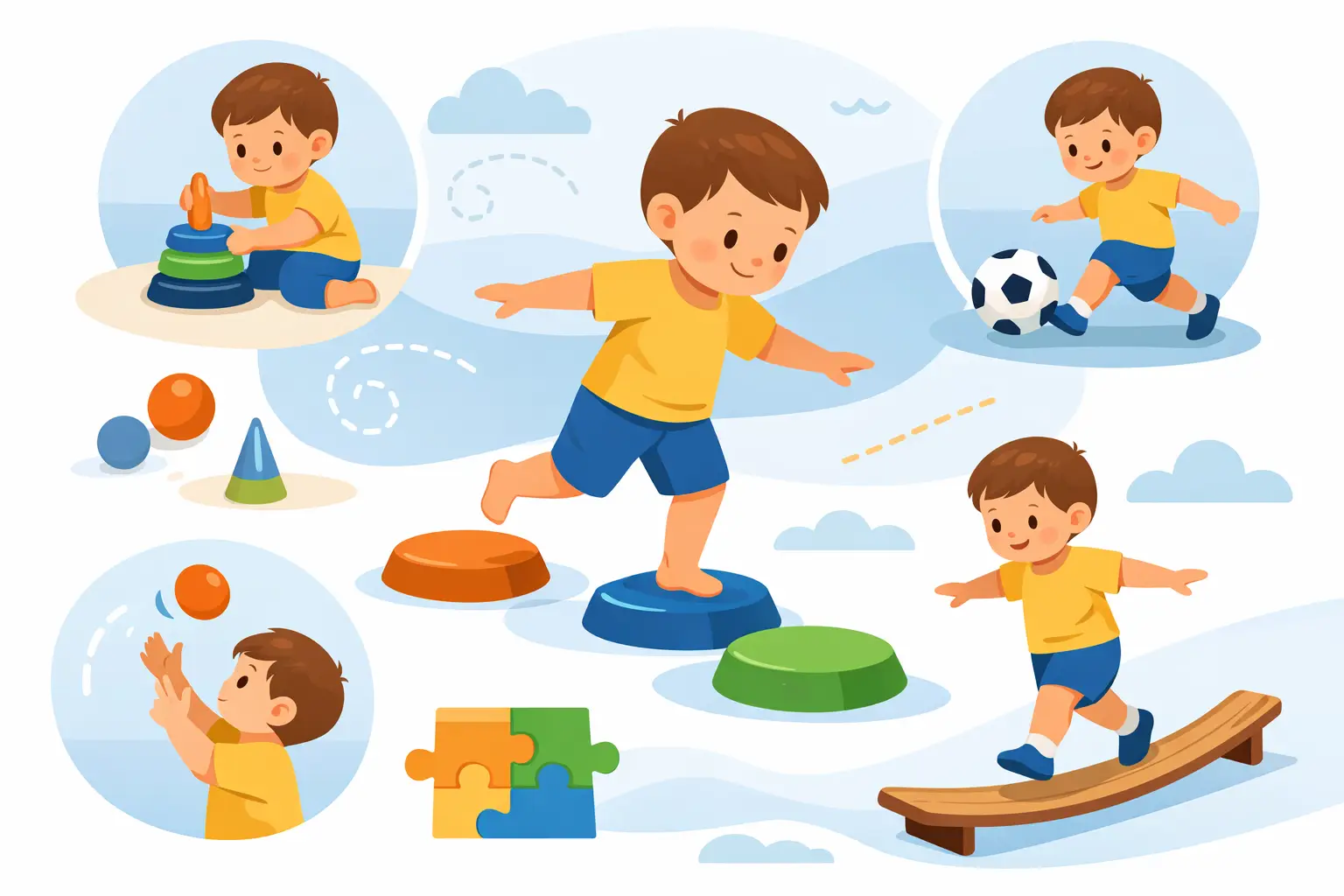
Rolling, tossing, and gently kicking a soft ball are some of the easiest places to start. These activities help toddlers judge distance, time their movements, and connect what their eyes see with what their body does. A large, lightweight ball is often easier than a small one because it moves more slowly and gives your child more time to respond.
Obstacle courses also work well because they combine multiple coordination skills at once. Walking around cushions, stepping over a line of toys, crawling under a chair, and carrying a beanbag to a target can all happen in a few minutes at home. The point is not making the course elaborate. The point is giving your toddler chances to balance, adjust, and move in different ways.
Music can help too. Marching, clapping to a beat, spinning, freezing, and changing direction all support body control. Rhythm gives toddlers a predictable structure, which often helps children who seem hesitant or easily distracted during physical play.
Purposeful parent-child play can be especially effective because toddlers are more willing to try something new when they feel secure. In programs like TigerTOTS Golf, that shared participation matters. A young child is not just copying a movement. They are learning through connection, repetition, and encouragement.
Focus on the foundations before technique
Parents sometimes worry that their child is not ready for structured movement because they cannot yet follow complex directions. In reality, early coordination work should stay very simple. Toddlers do not need detailed instruction about form. They need foundational experiences that prepare them for control later.
Core stability is one of the biggest pieces. When a toddler can hold their trunk steady, their arms and legs can move with more control. Climbing at a playground, crawling through tunnels, reaching while kneeling, and squatting to pick up toys all build this naturally.
Weight shifting is another key skill. Many coordinated movements depend on a child learning how to transfer weight from one foot to the other, or from one side of the body to the other. Stepping stones, gentle kicking games, and activities that involve turning and reaching help with this.
Then there is crossing the midline, which sounds technical but shows up in everyday play. When a child reaches across their body to grab a toy, swing a club, or tap a target, they are strengthening an important movement pattern tied to coordination and later skill development.
Create repetition without making it feel repetitive
Toddlers need repetition, but they do not always want the exact same setup every time. That is where small changes make a big difference. If your child enjoys rolling a ball into a basket, the next day they can roll it between two cones. If they like tossing beanbags, you can move the target closer or farther away. If they enjoy swinging at a ball on the ground, you can change the object, the surface, or the direction.
This kind of variation keeps practice fresh while reinforcing the same underlying skills. It also lets you adjust based on your child’s mood and energy. Some days your toddler may be ready for a new challenge. Other days they may need a version that feels easier and more familiar.
That flexibility is part of helping coordination grow. Progress is rarely a straight line in early childhood. A child may seem very steady one week and less controlled the next, especially during growth spurts or periods of fatigue. That does not mean the skill is gone. It usually means their body is still organizing itself.
The role of confidence in toddler coordination
When parents think about motor development, they often focus on muscles and movement. Confidence is just as important. A toddler who feels rushed, corrected too often, or compared to older children may start avoiding movement challenges. A toddler who feels safe and capable is more likely to try again.
This is one reason success should come before difficulty. If an activity is too hard from the start, your child may lose interest quickly. But if they can experience a few wins, like making contact with a large ball or walking a simple path without falling, they are more likely to stay engaged.
Your language matters here. Instead of saying, “No, do it like this,” try, “You got the ball moving,” or “I saw you balance all by yourself.” Encouragement tied to effort and discovery helps children feel proud of the process, not just the outcome.
When structured activities help most
Free play is valuable, but some toddlers benefit from gentle structure. A well-designed class can introduce movement patterns in a clear, age-appropriate way while keeping things playful and low-pressure. This can be especially helpful for parents who want ideas beyond basic playground time or who are unsure how much challenge is right.
The best early childhood movement programs do not expect toddlers to perform like older kids. They break skills into simple, repeatable actions and build them through games. They also involve parents in a meaningful way, which helps children feel supported while giving adults a better understanding of how development happens.
Golf-based movement can fit surprisingly well here when it is taught with child development in mind. Reaching, turning, balancing, tracking, swinging, and targeting all support coordination. The value is not in pushing sport technique too early. It is in using age-appropriate golf activities to strengthen broad motor skills that carry into many areas of childhood movement.
Signs your toddler is building coordination
You may not notice progress in dramatic leaps. More often, it shows up in small changes. Your child may fall less often when turning. They may start stopping with more control instead of crashing into furniture. They may be able to kick a ball without losing balance, stack movement steps together more easily, or show more willingness to try a new activity.
Attention span during physical play often grows too. As coordination improves, tasks feel less frustrating. That means your child may stay with an activity longer, repeat it more willingly, and show more pride in what they can do.
If your toddler is still very clumsy, seems unusually stiff or floppy, avoids movement often, or struggles significantly compared with what you see in daily life expectations, it can be worth bringing up with your pediatrician. There is a wide range of normal, but parents should always trust their instincts if something feels off.
Simple habits that support coordination every week
The biggest gains usually come from consistency, not intensity. A few minutes of active, purposeful play most days can do more than a long session once in a while. Try to give your child regular chances to carry, throw, roll, reach, climb, squat, balance, and change direction.
Screen-free floor time helps. Outdoor play helps. Playing with you helps. So does letting your toddler move at their own pace instead of constantly being lifted, positioned, or hurried along.
If you want to know how to improve toddler coordination, start by making movement part of family life in a calm, encouraging way. Not every activity needs to look impressive. What matters is that your child keeps getting chances to practice how their body works, one playful repetition at a time.
A coordinated toddler is not a child who does everything perfectly. It is a child who feels steady enough to explore, brave enough to try, and supported enough to keep going.