

A child misses the ball, looks up at their parent, and waits to see what happens next. That small moment matters more than the swing itself. When families build confidence through golf play, children are not just learning how to hold a club or tap a ball toward a target. They are learning that trying, adjusting, and trying again feels safe.
For children ages 2 to 5, confidence does not usually grow from pressure or correction. It grows from success that feels possible, movement that feels playful, and support that feels steady. That is why golf can be such a valuable early childhood activity when it is taught in the right way. Done well, it becomes a simple, structured setting where children practice courage in small doses.
Why golf play helps young children feel capable
Young children build confidence through repeated experiences of doing something for themselves. In golf-based play, those experiences happen naturally. A child carries their own club, aims at a target, swings, watches the ball move, and connects their action to a result. Even a tiny result matters.
That cause-and-effect cycle is powerful for preschoolers. It teaches them that effort changes outcomes. They begin to trust their body, their choices, and their ability to keep going when something does not work the first time.
Golf also has a pace that suits many young children. Unlike faster team sports, it creates room to pause, reset, and try again. For some children, that slower rhythm reduces overwhelm. For others, it offers a chance to practice patience and focus. Either way, the activity can meet different personalities well, which is one reason confidence-building through golf play can be so effective.
Build confidence through golf play, not pressure
Parents often worry about whether their child is shy, cautious, easily frustrated, or not naturally sporty. Those concerns are understandable. But confidence is not something a child either has or does not have. It develops through experiences, and those experiences need to match a young child’s stage of growth.
That means early golf should not look like formal coaching for older players. A 3-year-old does not need a long explanation of mechanics. They need a clear goal, a playful challenge, and the chance to feel, "I can do this."
When adults focus too much on technique too soon, children can start to connect performance with approval. That usually works against confidence. When adults focus on participation, curiosity, and progress, children stay engaged longer and become more willing to attempt something new.
This is where purposeful play matters. Purposeful play is not random activity. It is a guided experience with a developmental goal. In a golf setting, that might mean rolling a ball to a color target, balancing before a swing, or taking turns in a simple parent-child game. The child experiences fun, but there is also structure underneath it.
What confidence looks like in early golf
Confidence in a young child is not always loud. It does not always look like excitement or instant independence. Sometimes it looks like walking onto the playing area without clinging. Sometimes it looks like taking another turn after a miss. Sometimes it is simply being willing to hold the club, listen, and join in.
Parents can miss these signs if they are expecting dramatic change. In reality, the strongest confidence often grows quietly. A child who once avoided group participation may start volunteering. A child who became upset after one mistake may begin resetting more quickly. A child who needed constant help may start saying, "I do it."
These small shifts are worth noticing because they show a deeper change. The child is not just improving at golf play. They are building trust in themselves.
The role of coordination and movement
Confidence and motor development are closely connected in early childhood. When children feel more in control of their bodies, they often feel more secure emotionally too. Golf play supports this by encouraging balance, hand-eye coordination, body awareness, and controlled movement.
For example, a child who learns to line up a putt, steady their feet, and make contact with the ball is practicing much more than golf. They are learning how to organize movement with intention. That sense of control can carry into other areas, from playground play to classroom participation.
It is not a perfect equation, and every child develops at a different pace. Some children gain emotional confidence before physical confidence, while others show the opposite pattern. Still, the connection is strong enough that movement-based activities often give children a helpful path toward self-belief.
How parents help build confidence through golf play
Parent participation can make a major difference, especially for young beginners. When a trusted adult joins the activity, the environment feels safer and more predictable. That security gives children more freedom to explore.
The key is how the parent participates. Children benefit most when parents act as calm guides, not sideline critics or over-helpful fixers. If a child misses the ball, a supportive response might be, "You stayed with it. Try one more." That keeps attention on effort and resilience instead of failure.
It also helps when parents allow children to do what they can independently, even if it takes longer or looks messy. Placing the ball, carrying equipment, waiting for a turn, and choosing a target all build ownership. Ownership is one of the roots of confidence.
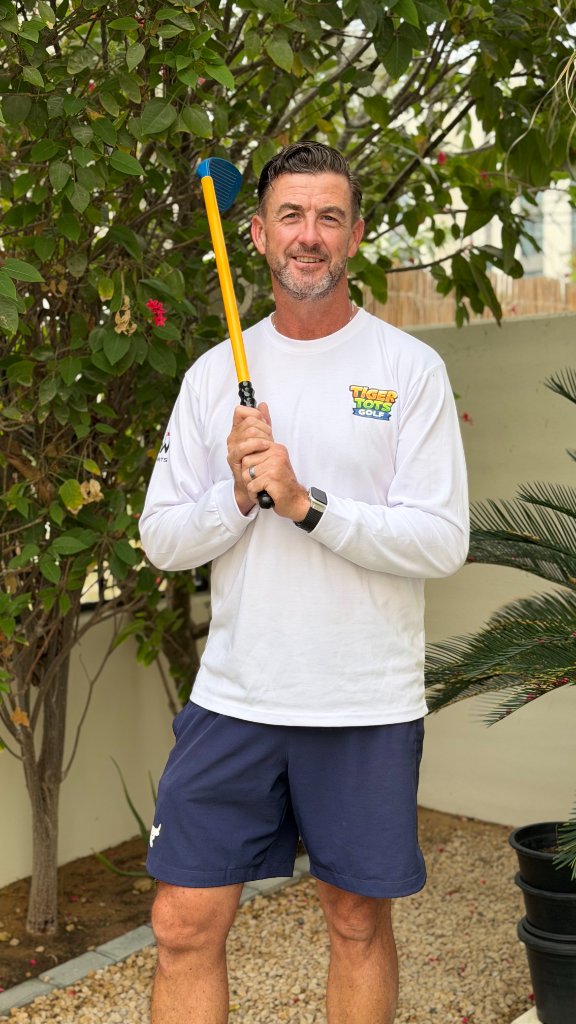
At TigerTOTS Golf UAE, this parent-child model matters because it turns learning into a shared experience rather than a performance. For many children, that makes trying feel less risky and more enjoyable.
Simple habits that support confidence
Children respond well to routines. In golf play, a simple rhythm can help them feel prepared and capable. The routine does not need to be complicated. It might be set the feet, look at the target, swing, and celebrate the effort.
Language matters too. Specific praise is usually more helpful than broad praise. "You kept your eyes on the ball" gives a child something clear to repeat. "Good job" is kind, but it does not always tell them what went well.
It is also useful to keep challenges achievable. If a task is too easy, children lose interest. If it is too hard, they may shut down. The sweet spot is a challenge that requires effort but still gives them a real chance of success. That balance is where growth happens.
When a child seems hesitant or frustrated
Not every child jumps into a new activity with excitement. Some need time to watch first. Others enjoy the game one day and resist it the next. That does not mean golf is not helping. Early confidence-building is rarely a straight line.
If a child is hesitant, start smaller. Rolling a ball into a target may feel easier than swinging. Standing beside a parent may feel better than taking a solo turn. The goal is not to force participation. The goal is to keep the experience positive enough that the child stays open.
Frustration needs the same thoughtful response. A little frustration can be healthy because it teaches persistence. Too much can overwhelm a young child and make them avoid the activity. If frustration rises, it often helps to shorten the task, return to a success they know, or take a playful break before trying again.
That trade-off matters. Challenge builds confidence, but only when the child still feels supported inside the challenge.
Why early confidence matters beyond the golf class
When children feel capable in one setting, they often carry that feeling into others. A child who learns to try again after a missed putt may be more willing to attempt a new skill at school. A child who grows comfortable following simple instructions in class may find transitions easier elsewhere. A child who experiences calm support from a parent during play may become more secure in unfamiliar environments.
This is one reason early enrichment works best when it focuses on development first. Golf is the vehicle, but the bigger outcome is the child’s growing sense of "I can try," "I can learn," and "I can keep going."
That does not mean every child will love golf long term, and that is fine. The value of early golf play is not dependent on raising a future golfer. It is about giving children a structured, enjoyable way to practice coordination, emotional regulation, listening, social participation, and confidence.
A better way to think about progress
Parents sometimes look for visible skill milestones, like stronger swings or cleaner contact. Those are meaningful, but they are not the only signs of progress. For young children, progress also looks like staying engaged for longer, recovering from mistakes more calmly, and joining activities with less hesitation.
When you view development this way, golf play becomes more than an activity to fill time. It becomes a place where confidence is practiced in real time, through movement, repetition, encouragement, and connection.
A confident child is not a child who never struggles. It is a child who begins to believe that struggle is manageable, support is available, and trying again is worth it.