

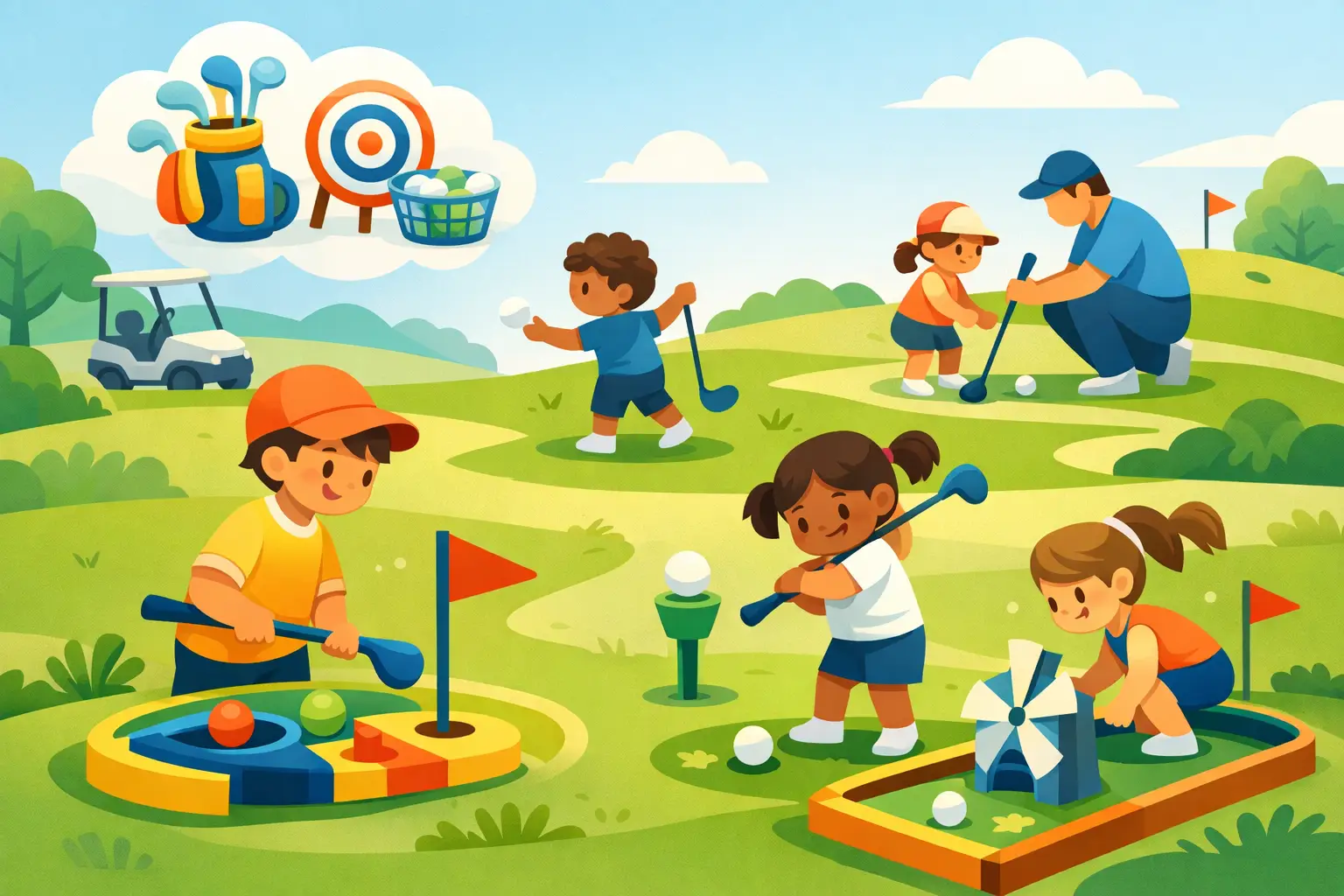
A toddler does not need to know how to grip a club perfectly to enjoy golf. They need a safe space, a simple challenge, and a grown-up who celebrates the small wins: a gentle swing, a ball that rolls forward, or the proud walk to collect it. The best golf games for toddlers use those moments to support coordination, listening, confidence, and joyful parent-child connection.
For children ages 2 to 5, golf should feel like purposeful play rather than a lesson in technique. Short games with clear goals work far better than repeated instructions. A few minutes of focused fun is enough to practice a movement, then move on before attention wanders.
What Makes the Best Golf Games for Toddlers?
A good toddler golf game has one simple job. It might encourage a child to aim, balance, swing gently, notice colors, or take turns. When there are too many rules, young children can become frustrated before they have had a chance to succeed.
Choose soft, child-sized equipment whenever possible, and create plenty of room between players. Foam balls, plastic clubs, rolled-up socks, paper cups, and painter’s tape can all become useful play tools. Adult supervision matters throughout, especially when clubs are involved. Teach children that a club stays low, points toward the ground, and is only swung when everyone is standing safely behind them.
The goal is not to create a miniature golfer overnight. It is to give your child repeated experiences of trying, adjusting, and feeling proud of their progress. That confidence carries into every new movement challenge they meet.
7 Best Golf Games for Toddlers
1. Color Cup Putting
Place three to five plastic cups or small buckets on the floor or grass. Give each one a different color, then ask your child to roll or putt a ball toward a chosen color: “Can you send the yellow ball to the blue cup?”
This game develops visual tracking, early color recognition, and gentle force control. Start with the cup close by, perhaps two or three feet away. As your child becomes more comfortable, move it a little farther away or make a wide target smaller. If the ball does not go in, praise the effort and invite another try. For toddlers, getting close is often just as exciting as scoring.
2. Animal Walk Golf
Set up a simple putting target, then turn the trip to the ball into an animal movement game. Your child can waddle like a penguin, hop like a bunny, stomp like an elephant, or crawl like a bear before taking their next turn.
Animal Walk Golf combines golf play with whole-body movement. Toddlers are still learning how their bodies move through space, and these playful actions build balance, leg strength, body awareness, and coordination. Keep the putting distance short, especially for younger children. The movement is the main challenge, while the putt gives the game a satisfying finish.
3. The Red Light, Green Light Swing
This game teaches one of the most valuable early golf habits: awareness before movement. Have your child stand beside their ball with the club resting on the ground. When you say “red light,” they freeze. At “yellow light,” they make a tiny practice swing. At “green light,” they gently tap the ball.
The game helps children practice listening, self-control, and safe club handling without making safety feel like a lecture. Keep your language positive and predictable. If a child swings early, simply reset with a smile: “Let’s try that again. First we freeze, then we swing.”
4. Treasure Hunt Putt-Putt
Use small objects as “treasure” near a target area: a soft toy, colorful beanbag, scarf, or picture card. Your child has to putt the ball toward the treasure, then walk over to collect it after each attempt. You can make a short story around the game, such as helping a lost animal find its home.
Toddlers often stay engaged longer when a game has a little imagination behind it. The treasure does not need to be a prize every time. It can be part of the play: returning a toy to a basket, matching a color card, or placing a “magic gem” in a bucket. This game encourages aiming while giving children a reason to move, explore, and repeat.
5. Tunnel Roll Challenge
Create a tunnel using a cardboard box with both ends open, two chairs with a blanket draped safely across them, or a store-bought play tunnel. Invite your child to roll or putt a soft ball through the tunnel.
A tunnel gives toddlers a clear visual target. It is often easier for them to understand “send the ball through” than “aim straight.” Begin by letting them roll the ball by hand. Once they understand the goal, offer a club and encourage a gentle tap. This progression matters because it allows children to learn the idea of direction before adding the challenge of a golf tool.
6. Follow-the-Path Golf
Make a path on the floor with painter’s tape, pool noodles, sidewalk chalk, or a line of cones. The challenge is to keep the ball traveling along the path toward a finish line or cup.
This is one of the best golf games for toddlers because it turns putting into a visible problem to solve. A straight, wide path works well for beginners. Older preschoolers may enjoy a curved route, a stop at a “bridge,” or two paths where they choose which one to try. Avoid correcting every miss. Instead, use curious questions: “What happened when you tapped it harder?” or “Would a softer tap help it stay on the path?”
7. Parent-and-Child Relay
Set up a short course with two or three stations. At the first station, the parent rolls a ball to a marker. At the second, the child puts the ball toward a target. At the last, both walk together to retrieve it and celebrate with a high-five.
The relay is not about speed. It is about shared participation. Toddlers learn through watching and copying, and seeing a parent take a calm, playful turn can make a new skill feel safe to try. You can switch roles, too. Let your child give you a challenge: “Mom, can you hit the red cup?” Their growing sense of leadership is part of the learning.
How to Keep Toddler Golf Play Positive
One successful putt does not need to lead to ten more attempts. Follow your child’s energy. If they are laughing and asking for another turn, continue. If they begin throwing the ball, wandering away, or losing interest, it may be time to change the game, add a movement break, or finish on a happy note.
It also helps to focus praise on effort rather than results. Try phrases such as, “You kept your eyes on the ball,” “That was a gentle tap,” or “You tried again even when it was tricky.” This kind of feedback helps children notice what they did, not just whether the ball went into a cup.
Parents do not need golf experience to make these games meaningful. Your role is to guide, encourage, and keep the environment safe. At TigerTOTS Golf, that parent-child partnership is central because young children grow best when play is shared, supported, and designed for their stage of development.
Set aside a small space, choose one game, and let your child lead the pace. A soft ball rolling toward a colorful cup may look simple, but it can become a powerful little practice in courage, coordination, and the joy of trying something new.